
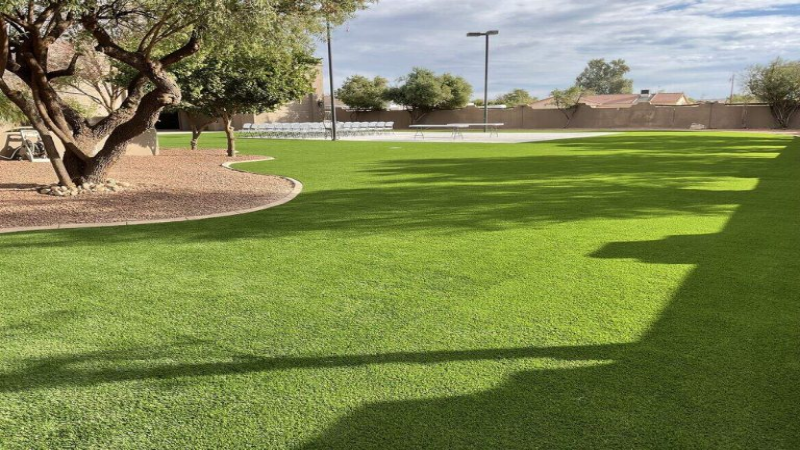
Curved edges and angled corners affect how artificial grass is measured, positioned, cut, and secured. For properties in Surprise, AZ, planning these details before artificial turf installation can reduce unnecessary material waste and create cleaner connections with patios, walkways, gravel, walls, and other fixed features.
Straight rectangular areas are generally simpler to measure because their dimensions follow predictable lines. Curved borders and unusual angles require more detailed planning since the turf must follow each shape while preserving consistent fiber direction and stable edges.
Why Do Curves Require Additional Planning?
Artificial turf is manufactured in rolls with fixed widths. A curved installation area rarely matches those straight dimensions, so installers must determine how each section will be positioned before cutting begins.
A narrow curve may require careful trimming along a patio, planter, or pathway. A wide arc might affect the placement of an entire turf roll. If the material is positioned without considering the complete shape, the project may require unnecessary seams or leave sections that cannot be used elsewhere.
The design should therefore be measured at several points instead of relying only on the longest length and widest width. These measurements help installers account for changes throughout the perimeter.
How Is Artificial Grass Measured for Curved Areas?
Measuring a curved area begins by identifying its widest and longest points. Installers may then divide the space into smaller sections that can be measured more accurately.
The turf plan should include enough material to extend beyond the final border during positioning. This extra material allows the installer to make controlled cuts that follow the actual edge. Ordering only the precise visible dimensions could leave too little room for fitting and trimming.
Existing structures must also be measured. Curved pool decks, circular planters, fire features, drainage openings, and rounded paver borders can all affect how much turf is required.
Accurate measurements support material planning, but the final cutting generally occurs at the property. Small variations in constructed borders may not appear on a basic drawing.
How Are Curved Turf Edges Cut?
During turf installation, the material is positioned over the prepared area and aligned according to the planned fiber direction. The installer then trims the backing gradually along the border.
Curves are usually created through a series of controlled cuts rather than one long cut made immediately. Removing too much material can create a visible gap that is difficult to correct. Gradual trimming allows the installer to check the fit as the turf follows the edge.
The blades should not be crushed or caught beneath nearby pavers. Once the cut is complete, fibers along the perimeter can be repositioned so the edge looks consistent with the rest of the surface.
What Makes Angled Corners Different?
Angled corners occur where walls, pavement, borders, or other features meet at something other than a standard right angle. They are common in side yards, irregular lots, geometric patios, and properties with diagonal walkways.
These corners can create narrow turf sections that require precise cutting. If the layout is not planned carefully, a seam may end at the corner or a small piece may be needed to fill the remaining space.
Whenever possible, installers plan roll placement so seams do not terminate at heavily used corners. The perimeter should also provide enough support to keep pointed or narrow sections from shifting.
The exact approach depends on the angle, surrounding materials, traffic level, and available fastening points.
Why Does Fiber Direction Still Matter?
Artificial grass fibers lean in a particular direction. As a result, the same turf can appear lighter or darker depending on the viewing angle.
When several sections are needed around curves or angled corners, their fibers should generally face the same direction. Rotating a leftover piece merely because it fits an unusual corner may create a noticeable color difference.
The main viewing direction from a patio, entrance, window, or seating area should be considered before the rolls are cut. Consistent orientation helps separate sections appear like one continuous surface.
This is also why material efficiency must be balanced with appearance. A smaller offcut may physically fill a corner, but it may not be suitable if its fibers face a different direction.
How Do Borders Support Curved Turf?
Borders provide a clear transition between artificial turf and adjacent materials. They can also create a stable perimeter that helps the cut edge hold its intended shape.
Pavers, concrete edging, gravel dividers, and other solid borders may be used around curved turf areas. The border should be installed at an appropriate elevation and follow a smooth, deliberate line.
Irregular spacing can become more noticeable along a curve. A consistent border width helps the finished design appear intentional instead of uneven.
Where turf meets loose gravel, separation is especially important. Without a defined edge, stones may migrate onto the turf while the base beneath the perimeter becomes exposed.
Can Curves Affect Drainage?
Curved edges do not automatically create drainage issues, but the broader shape and elevation of the area can influence where water travels. A border should not trap runoff or prevent water from reaching an appropriate drainage point.
Before artificial turf installation begins, installers should review nearby pavement, walls, downspouts, drains, and low areas. The prepared base should support water movement across and beneath the turf without directing it toward buildings.
This is particularly relevant in Surprise, where periods of limited rain can be interrupted by concentrated monsoon rainfall. Drainage decisions should be based on the whole property rather than the appearance of the turf border alone.
Are Curves Suitable for Small Turf Areas?
Curved edges can work well in compact yards because they soften rigid property lines and create visual separation between different surfaces. However, too many tight curves may result in complicated cuts and narrow turf points.
The shape should relate to how the area will be used. A broad curve may provide a comfortable route around a seating area, while a sharp corner could become an awkward place for foot traffic.
Simple curves are often easier to measure, install, and connect with surrounding materials. The goal is not to add curves everywhere, but to use them where they support the dimensions and function of the property.
TURFD provides information about Artificial Grass Installation for residential and commercial properties in Surprise. Their project planning considers the installation area, intended use, drainage, existing features, and connections with nearby materials.
Plan the Shape Before Selecting the Turf Layout
Curves and angled corners can add structure and visual interest to an artificial grass area, but they require accurate measurements and controlled cutting. Fiber direction, roll width, seam placement, drainage, borders, and the intended use of the space should all be evaluated before installation begins.
Before starting a project in Surprise, document the area from several angles and identify every curved border, narrow point, and fixed feature. Contact a qualified installer to assess the property and develop a turf layout that fits its shape and everyday use.