
Simply put:
-
New England engineers and OEMs sourcing magnetic shielding materials in New England, ND have access to a full range of high-permeability alloys — from mumetal sheets and foil to cryogenic-grade alloys — available in standard and custom forms.
-
Choosing the right alloy depends on field frequency, operating temperature, and whether you need raw stock or a fully fabricated shield.
Engineers working in New England’s aerospace, medical, and defense sectors routinely need to isolate sensitive electronics from electromagnetic interference. The right magnetic shielding material makes the difference between a device that performs reliably and one that fails under real-world field conditions.
What Makes a Material Effective for Magnetic Shielding
A magnetic shield’s ability to protect a magnetically sensitive component is determined by its permeability — a measure of the ability of a magnetic shield material to concentrate magnetic field lines within itself — and its saturation, which is the maximum ability of a material to concentrate those field lines.
The shielding capability of high-permeability materials arises from their ability to provide a low-reluctance path for magnetic flux that steers field lines around the shielded volume. In practical terms, this means a well-chosen alloy redirects interference away from the sensitive component rather than simply blocking it.
The shape and type of materials used for magnetic shielding depend on the strength and frequency of the magnetic field being redirected. Low-frequency DC and AC fields require different alloy grades than higher-frequency EMI, so material selection must begin with a clear characterization of the interference source.
Common High-Permeability Alloys and Their Forms
Not just a fabricator of custom magnetic shields, MuShield is also a distributor of magnetic shielding materials. All of MuShield’s magnetic shielding materials meet ASTM A753 Alloy Type 2, 3, or 4 and are sourced from only the finest domestic and international mills. According to ASTM International, the ASTM A753 specification covers wrought nickel-iron soft magnetic alloys produced expressly for use in parts requiring high magnetic permeability, high electrical resistivity, and low coercive field strength.
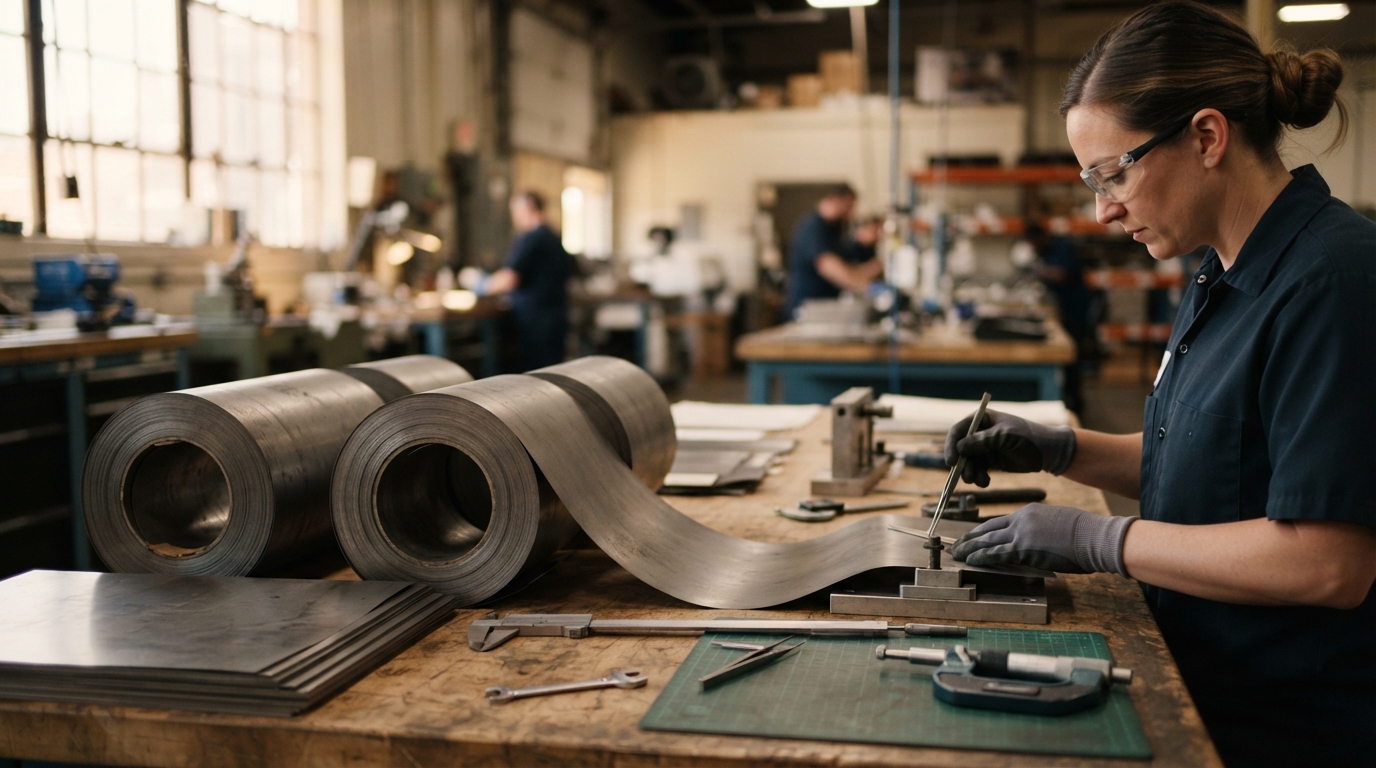
If you plan to manufacture your own magnetic shields using mumetal or Alloy 49, MuShield can supply these magnetic shielding materials in sheets, foils, round bar, wire, plates, forgings, and seamless tubing. All stock comes in a temper suitable for stamping, punching, bending, machining, and welding.
The table below summarizes the primary alloy families and their typical use cases:
|
Alloy |
Nickel Content |
Best For |
|
Mumetal / HyMu 80 |
~80% Ni |
Low-frequency shielding, precision electronics |
|
Alloy 49 / Permalloy |
~48-50% Ni |
Transformers, sensors, moderate-field applications |
|
Cryoperm / Cryophy |
~80% Ni + Mo |
Cryogenic environments (down to 4.2 K) |
Cryoperm and Cryophy are soft magnetic nickel-iron alloys with about 80% nickel and 4.2-5.2% molybdenum, a saturation induction of approximately 8,000 Gauss, the highest technically obtainable permeability (Max greater than 350,000), and a very low coercive force. Cryoperm exhibits very high permeability at very low induction, yielding superior magnetic shielding attenuation of low flux density magnetic fields.
Mu-metal, a nickel-iron alloy with very high magnetic permeability, is widely recognized as one of the most efficient shielding materials, often employed in MRI machines, scientific instruments, and other precision applications requiring magnetic shielding.
How Fabrication and Heat Treatment Affect Performance
Raw stock alone does not determine final shielding effectiveness. The fabrication process — and especially heat treatment — play a critical role.
After working with high-permeability magnetic shielding alloys such as mumetal and HyMu 80, experienced fabricators source all materials from specialty mills at a specified temper, chemical composition, and grain size to ensure that the material will serve to shield the magnetic flux it is designed for.
Industry leaders in high-precision sheet metal fabrication and bar stock machining of high-permeability mumetal and HyMu 80 maintain vacuum and hydrogen furnaces on-site used for both in-process stress relief annealing and final heat treatment. Skipping or shortcutting the annealing step after cold working can significantly degrade permeability, rendering even premium alloy stock far less effective.
Magnetic shielding precision fabricating is not the same as standard metal fabricating. Teams unfamiliar with the material’s sensitivity to mechanical stress often underestimate how bending, welding, or machining without subsequent heat treatment reduces shielding performance.
FAQ
What is the difference between mumetal and HyMu 80? Both are high-permeability nickel-iron alloys used for low-frequency magnetic shielding. HyMu 80 is a trade name for a composition that closely parallels mumetal, and the two are often used interchangeably in shielding applications. Specific permeability values can vary slightly by mill and heat treatment.
Can I buy shielding material stock without ordering a custom shield? Yes. If you require high-permeability materials to design your own shields, sheet, foil, tubing, and bar stock are available in stock. Sample kits are also offered for engineers who need small quantities for testing.
When should I choose a cryogenic-grade alloy? Cryoperm, Cryophy, and other equivalent cryogenic magnetic shielding alloys are the alloy of choice for cryogenic applications, exhibiting very high permeability at 4.2 to 10 degrees Kelvin.
Does the form factor (sheet vs. tubing) affect shielding performance? Form factor affects geometry, and geometry affects shielding effectiveness. Enclosures generally outperform flat sheets for omnidirectional protection. Magnetic shielding is often application-specific, and the details can vary depending on the strength of the magnetic field involved.
Work With a New England Magnetic Shielding Specialist
MuShield’s manufacturing facility is located in Londonderry, New Hampshire, just minutes from the Boston-Manchester Regional Airport, making rapid delivery possible. Whether you need raw alloy stock or a fully fabricated and heat-treated custom shield, The MuShield Company offers both material distribution and complete in-house fabrication, giving New England engineering teams a single source for their shielding projects from design through delivery.