
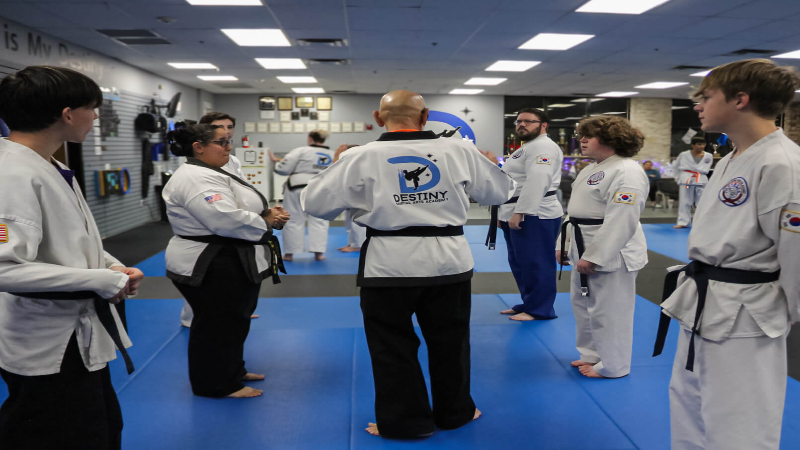
Distance matters in partner training because every technique works best within a certain range. If a student is too close or too far away, balance, timing, accuracy, and control can all be affected.
In adult martial arts, learning to judge distance is part of understanding how techniques function with another person rather than only in solo practice. For adults training in Peoria, AZ, partner drills can help make spacing more practical and easier to recognize.
What Does Distance Mean in Martial Arts Training?
Distance refers to the amount of space between two people during an exercise.
That space changes constantly as partners step forward, move backward, turn, or change position. A technique that works from one distance may not work the same way from another.
For example, a hand technique may require the student to be relatively close, while a kick usually needs more space to extend properly. Students in martial arts for adults therefore learn to recognize whether they are standing at a useful range before beginning the movement.
This prevents unnecessary reaching or crowding.
What Happens When a Student Is Too Far Away?
Being too far away can cause several problems.
A student may lean forward, extend beyond a stable position, or take an awkward step just to reach their partner. These adjustments can change the mechanics of the technique.
Overreaching may also make it harder to return to a balanced stance afterward.
During adult karate classes, instructors may correct distance before correcting the strike itself because the technique can look inaccurate simply because the student started from the wrong position.
Once the range is adjusted, the movement may become easier to perform correctly.
Why Can Being Too Close Be a Problem?
Standing too close creates a different set of challenges.
A student may not have enough room to complete a movement naturally. A punch can become cramped, a kick may not have enough space to extend, and the body may need to twist or lean unnecessarily.
This can also make partner practice feel rushed.
In karate for adults, learning to maintain enough space gives students more time to see the movement, respond appropriately, and stay in a stable position.
Good distance is therefore not simply about reaching the other person. It is about having enough room to perform the technique as intended.
How Does Distance Affect Timing?
Timing and distance are closely connected.
A technique may be performed at the correct moment but still fail to line up if the student is standing at the wrong range. Likewise, a student may be at the right distance initially but lose that position if the partner moves.
Partner drills help students learn that timing is not fixed.
They have to watch how the other person changes position and adjust their own movement accordingly. This can involve stepping before a technique, changing direction, or waiting until the spacing is more appropriate.
That makes distance a dynamic part of training rather than a measurement students memorize once.
Why Is Footwork Important for Managing Range?
Students control distance largely through footwork.
Small steps can change whether a technique is too short, properly aligned, or overextended. This is why foot placement becomes increasingly important as partner exercises become more complex.
A student may need to step forward to close space, move back to create more room, or shift at an angle rather than moving in a straight line.
In karate martial arts, the lower body helps position the upper body before a technique is performed.
Without controlled footwork, students may rely too heavily on leaning or reaching instead of moving their entire body into a better position.
How Does Correct Distance Support Better Balance?
Proper range can help students maintain a more natural stance.
When the distance is appropriate, the student does not need to stretch excessively or crowd their partner. They can perform the movement while keeping their weight distributed more effectively.
This makes it easier to recover after the technique.
Balance matters because partner training rarely ends after one movement. A student may need to return to position, continue into another technique, or respond to a new movement immediately afterward.
Starting at the correct range can make those transitions more controlled.
Why Does Partner Height Change Distance?
Not every training partner has the same reach or body proportions.
A taller partner may naturally have a longer striking range, while a shorter partner may need to step closer before performing the same technique. Arm length, leg length, and stance width can all change the amount of space required.
This is one reason partner practice is useful.
Students cannot rely on one fixed distance for every person. They learn to observe the partner in front of them and make adjustments.
Structured adult martial arts training can help adults become more familiar with how range changes when working with different people.
How Do Adults Learn to Judge Distance Without Measuring It?
Students usually develop this skill through repeated practice.
At first, an instructor may provide clear positioning cues. Over time, students begin to recognize distance visually and physically.
They notice how far the arm extends, how much room is needed for a kick, or whether a step places them too close to their partner.
Eventually, the process becomes less deliberate.
Instead of thinking about exact measurements, the student begins to recognize whether the spacing feels appropriate based on the movement they are preparing to perform.
Why Is Controlled Distance Important During Partner Drills?
Partner work requires both students to understand the purpose and intensity of the exercise.
Maintaining proper spacing helps make movements more predictable and controlled. It also gives each person enough room to complete the drill without unnecessary contact or awkward positioning.
When distance changes unexpectedly, students must respond by adjusting their stance or footwork rather than forcing the technique.
This reinforces an important lesson: a movement should adapt to the situation instead of being performed exactly the same way regardless of range.
How Does Distance Become More Important as Training Progresses?
As adults become more comfortable with individual techniques, partner drills may include more movement, changing angles, and longer combinations.
At that point, distance becomes harder to maintain because both people are moving.
The student must continually evaluate whether they are close enough, too close, or outside the useful range for the next movement.
For adults in Peoria, AZ, this makes distance an important technical concept throughout martial arts training. Learning to manage spacing can improve balance, timing, footwork, and control while helping students understand how techniques change when another person is actively moving in front of them.